
Turning expertise into scalable income means building repeatable, systematized products or services that generate revenue independent of the hours you work. The industry term for this is expertise monetization, and it covers everything from digital courses and licensing deals to productized consulting. The PepperEffect model proves the concept works at scale: hybrid monetization models combining fixed fees of $3,000–$15,000 with monthly subscriptions of $2,000–$8,000 achieve EBITDA margins of 70–78%. That margin is not an accident. It is the direct result of decoupling revenue from personal hours through systems, intellectual property, and licensing.
How to turn expertise into scalable income: what you need first
Before you build anything, you need to confirm three things: market demand, proficiency level, and consistent delivery capability. Skip any one of these and you are building on sand.
Market demand means real people are already paying for solutions to the problem your expertise solves. Use Google Trends, Udemy course enrollment numbers, and Reddit communities to confirm demand before you invest time creating a product. If you find courses on your topic with thousands of enrollments, demand is confirmed.

Proficiency level is about being two to three steps ahead of your buyer, not being the world's foremost authority. A mid-level financial analyst who can explain tax optimization clearly beats a PhD economist who cannot communicate. The skill validation process at Theunwillingexpert focuses exactly on this gap: identifying what you know that others will pay to learn.
Consistent delivery capability means you can produce the same result repeatedly without heroic effort. If your best work requires perfect conditions, you cannot productize it yet. Document your process first, then build the product.
Skills that pass all three criteria can generate $100–$1,500 monthly with the right monetization approach. That range reflects the difference between a poorly matched model and a well-matched one.
| Requirement | What to Check | Best-Fit Model |
|---|---|---|
| High market demand, broad audience | Search volume, course sales | Digital products, online courses |
| Deep technical proficiency | Client results, case studies | Consulting, licensing |
| Strong communication skills | Content engagement, testimonials | Coaching, membership communities |
| Repeatable process or framework | Documented SOPs, templates | Productized services, guides |
Pro Tip: Before building anything, run a paid workshop or a $97 mini-course on Gumroad or Teachable. If it sells without a large audience, your skill clears the market demand test.
Which monetization model fits your expertise?
Matching the right model to your specific skill type is the single most important decision in this process. Mismatches cause slow growth and frustration, not lack of effort.
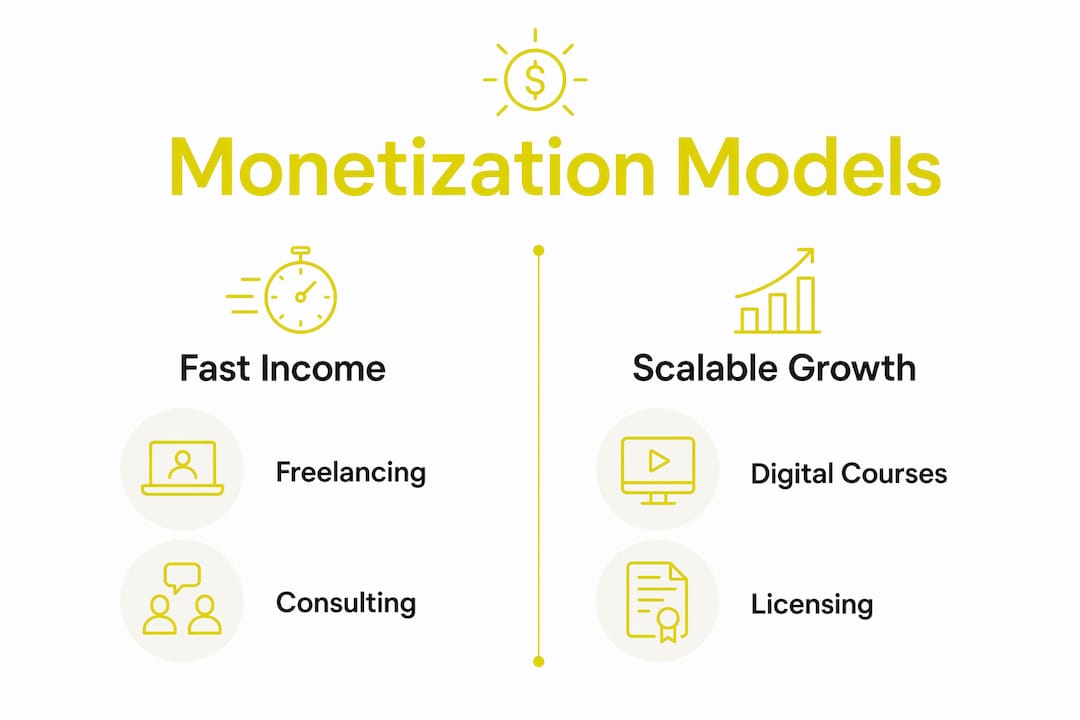
Here is how the main models compare:
| Model | Income Ramp | Scalability | Upfront Investment |
|---|---|---|---|
| Freelancing / consulting | Fast (weeks) | Low | Minimal |
| Online courses | Medium (3–6 months) | Very high | Moderate |
| Digital products (guides, templates) | Fast (days) | High | Low |
| Coaching programs | Medium | Moderate | Low |
| Licensing / IP | Slow (6–12 months) | Extremely high | High |
| Membership communities | Medium | High | Moderate |
Freelance services produce the fastest income ramp, while recorded courses and consulting have longer ramps but higher ceilings. This is not a flaw in the system. It is the natural trade-off between speed and scale.
The most effective approach combines models in a tiered structure. A tiered monetization structure with low-ticket digital products priced at $17–$97, mid-tier workshops at $97–$297, and high-ticket coaching at $500–$3,000 creates a clear path to $5,000 per month. Each tier qualifies buyers for the next level, so your marketing effort compounds over time.
Hybrid approaches work especially well for consultants. Combining a digital product library with a group coaching program means you earn from both passive buyers and active clients simultaneously. The digital products handle volume. The coaching handles premium revenue.
How do you productize expertise step by step?
Productizing your knowledge follows a specific sequence. Skipping steps wastes time and produces offers nobody buys.
-
Identify your repeatable framework. Write down the exact steps you take to deliver your best client result. If you cannot write it down in under 10 steps, you do not have a productizable process yet. Keep working until you do.
-
Choose your first product format. Start with the lowest-friction format: a PDF guide, a template pack, or a short video course. Low-ticket guides and templates qualify buyers for higher-ticket programs. They also prove demand before you invest 200 hours in a full course.
-
Price on outcome value, not delivery time. A system that delivers $200K in revenue for a client is worth $10,000 regardless of how long it takes you to deliver. Pricing by the hour is the fastest way to cap your income permanently.
-
Incorporate AI and automation. AI tools like ChatGPT, Claude, and Zapier can automate 70–80% of consulting delivery. AI automation reduces bespoke work from 60-plus hours to roughly 12–15 hours while maintaining client value. That freed time goes directly into building more products or serving more clients.
-
Build the customer journey. Your $27 guide is not just a product. It is the entry point to your $297 workshop, which feeds your $1,500 coaching program. Design this sequence before you launch anything. Buyers who trust you at $27 convert to $1,500 at a dramatically higher rate than cold traffic.
-
Add licensing as the ceiling. Consultants who productize into licensing models increase enterprise value to 3x–5x revenue. Corporate licensing separates your expertise from your labor entirely. Clients pay a flat annual fee. You deliver zero service hours. This is the end goal of the entire system.
Pro Tip: Record every client call and delivery session for the first 90 days. Patterns in your answers become your FAQ guide, your course modules, and your licensing framework. You are already doing the work. Capture it.
What are the most common mistakes when scaling expertise?
The biggest structural mistake is the Consultant's Iron Law: selling time for money with no exit. Every hour you bill is an hour you cannot spend building a product that earns while you sleep. Recognizing this trap is step one. Getting out requires a deliberate transition plan, not just good intentions.
Watch for these specific errors:
- Underpricing digital products. A $7 PDF signals low value and attracts buyers who will never upgrade to coaching. Price your entry product at $17–$47 minimum to attract buyers with real intent.
- Building without validating. Spending three months on a course before selling a single seat is a common and expensive mistake. Sell the course first as a live cohort. Build the recorded version only after you have paying students.
- Ignoring delivery quality at scale. When you move from 5 clients to 500 customers, your support load multiplies. Build a FAQ document, a community forum, or an AI-powered help desk before you scale, not after.
- Skipping the licensing opportunity. Most consultants stop at coaching. High-leverage licensing models allow businesses to pay flat annual fees for your methodology, creating zero-overhead revenue. This model supports valuations of 5x–8x EBITDA instead of the 1x–2x typical for time-based consulting.
What is often called passive income is better understood as leveraged income. You invest time or capital upfront, and that investment yields future income independent of active work. The distinction matters because it sets realistic expectations. You will work hard building the system. Then the system works for you.
Pro Tip: Run a 30-day "offer audit" every quarter. Pull your sales data, identify which products convert best, and cut or repackage the ones that do not. Iteration beats perfection every time.
Key takeaways
Productizing expertise into systems, digital products, and licensing is the only reliable path to income that scales beyond your available hours.
| Point | Details |
|---|---|
| Validate before you build | Confirm market demand, proficiency, and delivery consistency before creating any product. |
| Match model to skill type | Mismatched monetization models cause slow growth; use the comparison table to find your fit. |
| Price on outcome, not hours | A result worth $200K to a client justifies a $10K price regardless of delivery time. |
| Use AI to multiply capacity | Automating delivery with tools like ChatGPT reduces active hours by up to 80%. |
| Build a tiered customer journey | Low-ticket products qualify buyers for high-ticket coaching and licensing at higher conversion rates. |
The shift nobody tells you about
Most professionals I talk to treat expertise monetization as a side project. They keep their consulting calendar full, squeeze product creation into weekends, and wonder why nothing scales. That is not a time problem. It is a priority problem.
The real shift happens when you stop thinking of yourself as a service provider and start thinking of yourself as an intellectual property business. Your frameworks, your processes, your documented systems: those are assets. A service business dies when you stop working. An IP business compounds while you sleep.
I have watched professionals with genuinely valuable expertise stay stuck at $8,000 per month for years because they refused to stop taking one-off client calls. Every new client felt like revenue. Every new client was also a reason not to build the product that would replace ten clients. The math never worked in their favor.
The market in 2026 rewards systems, not availability. AI has made generic consulting cheaper and more accessible. What AI cannot replicate is your specific, documented, battle-tested methodology. That is your moat. Build it into a product, price it on outcomes, and stop trading hours for dollars. The passive income systems that actually work are not passive at the start. They are front-loaded. Do the work once. Collect the result indefinitely.
— dominick
Ready to build your scalable income system?
Theunwillingexpert strips the theory out of expertise monetization and gives you the execution blueprint. Whether you are mapping your first digital product, structuring a tiered offer, or moving toward licensing, the programs here are built for professionals who want results without the academic bloat.
Start with The Complete Blueprint for a full system covering skill validation, product creation, and income scaling in one structured volume. If you want to explore the full program catalog, the program list covers every track from financial strategy to high-performance execution. Check the plans and pricing page to find the right entry point for where you are right now.
FAQ
What does it mean to productize your expertise?
Productizing expertise means converting your knowledge and process into a repeatable, sellable format such as a course, guide, template, or licensing model. The goal is revenue that does not require your direct time for every transaction.
How fast can you start earning from a digital product?
Digital products on platforms like Gumroad or Teachable can generate first sales within days of launch. Freelance services produce the fastest income ramp, while courses and licensing take three to twelve months to build meaningful recurring revenue.
What is the best pricing strategy for productized expertise?
Price on client outcome value, not delivery hours. A system that generates $200,000 in revenue for a client justifies a $10,000 price tag regardless of how long it takes you to deliver.
How do licensing models work for consultants?
Licensing lets businesses pay a flat annual fee to use your methodology, framework, or system. You deliver zero service hours after setup. Consultants who move to licensing increase enterprise value to 3x–5x revenue compared to time-based models.
Do you need a large audience to monetize your skills?
No. Skills that pass market demand, proficiency, and delivery criteria can generate $100–$1,500 monthly without a large following. A focused niche and a validated offer outperform a broad audience with no clear product every time.