
Movement improves focus by increasing blood flow to the brain, triggering neurotransmitter release, and activating neuroplasticity pathways that sharpen attention and memory. Research from Harvard Medical School and Mercer University confirms that physical activity directly enhances cognitive function, not just mood. The science behind why movement improves focus is no longer theoretical. It is a documented biological process with clear, practical implications for anyone trying to get more done with a sharper mind. This article covers the mechanisms, timing, psychological benefits, and real-world strategies you can use today.
Why does movement improve focus? the biology explained
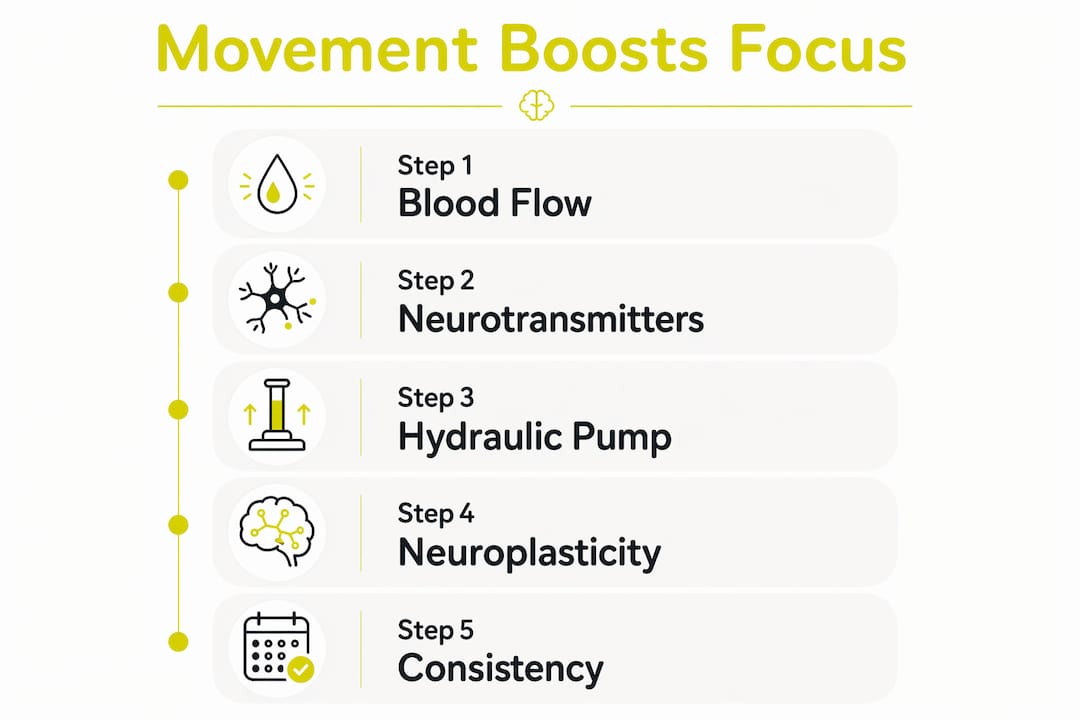
The core mechanism is blood flow. When you move, your heart pumps harder, and cerebral circulation increases, delivering more oxygen and glucose to neurons that need both to fire efficiently. More fuel means faster processing, better working memory, and stronger executive function. This is the foundation of how exercise enhances concentration at a physiological level.
Neurotransmitters are the second layer. Movement triggers the release of dopamine, norepinephrine, and serotonin. These chemicals regulate attention, motivation, and mood. Dopamine drives reward-seeking and task persistence. Norepinephrine sharpens alertness. Serotonin stabilizes mood so your brain is not fighting emotional noise while trying to concentrate.

There is a third mechanism most people have never heard of. Movement triggers a hydraulic pump effect in the brain. Abdominal muscle contractions during physical activity shift cerebrospinal fluid (CSF), which may clear neurotoxic waste products from brain tissue. Think of it as a built-in rinse cycle that only activates when you move. A sedentary brain, by contrast, sits in its own metabolic byproducts.
Exercise also activates neuroplasticity genes. Physical activity switches on epigenetic signals that promote the growth of new neural connections, particularly in the hippocampus, the brain region most associated with memory and learning. This is why the impact of movement on cognitive function compounds over time rather than plateauing after a single workout.
| Neurotransmitter | Released By | Cognitive Effect |
|---|---|---|
| Dopamine | Aerobic exercise, strength training | Motivation, task persistence, reward processing |
| Norepinephrine | Moderate to vigorous activity | Alertness, attention, stress response regulation |
| Serotonin | Sustained rhythmic movement | Mood stability, reduced cognitive interference |
| BDNF (Brain-Derived Neurotrophic Factor) | Aerobic exercise | Neuroplasticity, memory formation, learning |
Pro Tip: If you want the neurotransmitter boost without a full workout, a brisk 10-minute walk is enough to shift your brain chemistry. You do not need a gym.
How does timing and type of movement affect concentration?
Not all movement is equal, and when you move matters as much as how long you move. A 5-minute movement break every 30 minutes effectively mitigates cognitive fatigue and the physiological damage caused by prolonged sitting. That is a low bar with a high return.
Research from Mercer University found that a 10-minute moderate activity session improves attention by 12–18 minutes in students. That ratio, roughly 1 minute of movement buying 1.5 minutes of focus, is one of the most efficient cognitive investments available. The effect is not limited to children. The underlying neurology applies across age groups.
Short, frequent movement breaks throughout the day outperform a single long workout session for cognitive health. One hour at the gym does not cancel out eight hours of unbroken sitting. Distributed movement is the mechanism that keeps your brain performing across a full workday.
Here is how different movement strategies compare:
| Movement Type | Duration | Cognitive Benefit | Best For |
|---|---|---|---|
| Brisk walking | 10–20 min | Attention boost, dopamine release | Pre-task focus |
| Tai chi | 30–45 min | Memory, executive function, stress reduction | Sustained mental clarity |
| Micro-breaks (stretching, fidget pedals) | 2–5 min | Fatigue prevention, circulation | Desk workers, long sessions |
| Moderate aerobic exercise | 30–60 min | Long-term brain volume, mood regulation | Weekly cognitive maintenance |
Key activities worth building into your routine:
- Brisk walking activates dopamine and norepinephrine within minutes
- Tai chi improves both memory and executive function through complex movement patterns
- Stretching restores circulation and reduces muscle tension that competes with concentration
- Fidget pedals under a desk provide low-intensity continuous movement without interrupting work
Pro Tip: Track your movement breaks in a simple notes app or habit tracker like Streaks or Habitica. Correlating your logged breaks with your energy and output at the end of the day builds the feedback loop that makes the habit stick.
Does exercise improve attention and mood at the same time?
The relationship between movement and productivity runs directly through mental health. Exercise reduces stress, anxiety, and depression, three of the most common barriers to sustained attention. When your nervous system is in a threat state, your prefrontal cortex, the seat of focus and decision-making, goes offline. Movement brings it back.
Exercise benefits brain volume and cognition by improving mood, sleep quality, and stress levels simultaneously. These are not separate outcomes. They are a cascade. Better sleep means better memory consolidation. Lower stress means fewer intrusive thoughts competing for attention. Improved mood means stronger motivation to stay on task.
The benefits are especially pronounced for people with ADHD. Exercise immediately boosts dopamine and norepinephrine, neurotransmitters that are chronically low in ADHD brains. The ADD Resource Center notes that physical activity can mimic some effects of ADHD medication by improving executive function and impulse control. This is not a replacement for clinical treatment, but it is a documented cognitive lever.
Group exercise adds another layer. Social accountability from group fitness programs, running clubs, or even a walking partner improves routine adherence. Consistency is what converts a single workout into a lasting cognitive upgrade.
Mood benefits that translate directly to better focus include:
- Reduced cortisol levels, which lowers background anxiety that fragments attention
- Increased dopamine, which strengthens motivation and task initiation
- Improved sleep architecture, which sharpens next-day memory and recall
- Lower depression scores, which restore the mental energy needed for deep work
How can you use movement to boost your own productivity?
Start small. The biggest mistake people make is treating exercise as an all-or-nothing commitment. Harvard Medical School recommends 150 minutes of moderate-intensity exercise weekly, with cognitive benefits typically appearing after six months of consistent habit formation. That is 21 minutes per day. You do not need to run a marathon to think more clearly.
Build movement into your work environment
Standing desks, walking meetings, and micro-activity between tasks are not wellness theater. They are structural changes that keep your brain fueled across the day. A standing desk alone does not provide the movement stimulus your brain needs, but pairing it with brief walks every 30 minutes does. Walking meetings, popularized by companies like Apple and LinkedIn, produce the same cognitive benefits as a dedicated workout break while also getting work done.
Use habit stacking to make it automatic
Pair movement with tasks you already do. Walk while taking phone calls. Do five minutes of stretching before opening your laptop. Use a short walk as your transition ritual between deep work blocks. This approach removes the decision cost from the habit. You do not have to choose to move. The movement is already attached to something you were going to do anyway.
- Identify two or three daily anchors (morning coffee, lunch, end-of-day shutdown)
- Attach a 5-minute movement break to each anchor
- Track completion for two weeks using a habit app like Streaks, Habitica, or even a paper calendar
- Adjust intensity and duration based on how your energy and output respond
Tracking movement breaks correlates physical activity with mood and energy improvements, which reinforces the behavior. You are not just building a fitness habit. You are building evidence that movement works for you specifically.
Choose activities you actually enjoy. Tai chi, brisk walking, cycling, and yoga all produce the neurotransmitter and blood flow benefits described above. The best exercise for focus is the one you will repeat consistently. Intensity matters less than frequency.
Pro Tip: Pair your hardest cognitive task of the day with a 10-minute walk immediately beforehand. The dopamine and norepinephrine spike from the walk will prime your brain for the exact kind of focused, motivated work that task demands.
Key takeaways
Movement improves focus by delivering oxygen to the brain, clearing neural waste, and releasing dopamine, norepinephrine, and serotonin, and consistency over time is what converts these acute effects into lasting cognitive gains.
| Point | Details |
|---|---|
| Blood flow is the foundation | Movement increases cerebral circulation, delivering oxygen and glucose that neurons need to perform. |
| Short breaks beat long sessions | A 5-minute break every 30 minutes prevents cognitive fatigue more effectively than a single long workout. |
| Neurotransmitters drive attention | Dopamine and norepinephrine released during exercise sharpen alertness and improve executive function. |
| Mood and focus are linked | Exercise reduces stress and anxiety, removing the mental interference that blocks sustained concentration. |
| Consistency unlocks long-term gains | Harvard Medical School data shows cognitive benefits emerge after six months of regular moderate activity. |
Movement, focus, and what nobody tells you about consistency
I have watched a lot of people chase focus through apps, supplements, and productivity systems while completely ignoring the most reliable lever available. Movement is not a wellness trend. It is the operating system upgrade your brain has been waiting for.
The part that surprises most people is that intensity is almost irrelevant at the start. A 10-minute walk produces measurable attention improvements. You do not need to be an athlete to think like one. What you do need is repetition. The neuroplasticity benefits, the improved sleep, the lower baseline cortisol, none of that shows up after one session. It shows up after weeks of consistent, boring, undramatic movement.
I also think the somatic stress and nervous system angle is underrated. Most people experience focus problems not because they lack discipline but because their nervous system is stuck in a low-grade threat state. Movement is one of the fastest ways to reset that. A short walk does not just oxygenate your brain. It signals to your nervous system that the threat has passed and it is safe to think clearly again.
Track your results. Not obsessively, but enough to see the pattern. Two weeks of noting your energy and output after movement breaks will give you more motivation than any motivational article ever could. The data you collect on yourself is the most persuasive argument for continuing.
— dominick
Build the focus habits that actually stick
If the science in this article resonates, the next step is building the system around it. Theunwillingexpert's Sage Green track is built specifically for people who want to perform at a higher level without overcomplicating the process. The Digital Detox and Focus Protocols volume pairs movement-based focus strategies with screen management and attention training into a single, stripped-down framework.

No fluff, no academic padding. Just the mechanics of building a brain that works for you. Browse the full plans and pricing to find the right starting point.
FAQ
Why does movement improve focus so quickly?
Movement immediately increases blood flow and triggers dopamine and norepinephrine release, both of which sharpen alertness and attention within minutes. Even a 10-minute walk produces measurable attention improvements.
How much exercise is needed for cognitive benefits?
Harvard Medical School recommends 150 minutes of moderate-intensity exercise weekly, with consistent cognitive benefits typically appearing after six months of regular activity.
Does the type of movement matter for focus?
Both aerobic exercise and structured movement like tai chi improve focus, but the most important factor is consistency. Short, frequent movement breaks distributed throughout the day outperform a single long session for sustained cognitive performance.
Can movement help with ADHD and attention disorders?
Exercise boosts dopamine and norepinephrine, neurotransmitters that are chronically low in ADHD brains, and the ADD Resource Center notes that physical activity can improve executive function in ways that parallel some medication effects.
What is the minimum effective movement break for focus?
A 5-minute movement break every 30 minutes is enough to prevent cognitive fatigue and counteract the physiological effects of prolonged sitting, making it one of the most efficient focus strategies available.